
The Burned German Shepherd Was Found Inside a Collapsing House With Flames Spreading Toward an Oxygen Tank, and Although the Rescue Team Believed She Was Protecting the Cylinder Out of Fear and Aggression, Nobody Realized the Injured Dog Was Using the Last of Her Strength to Keep Someone Hidden Beneath the Ruins Alive
PART 1
The Burned German Shepherd Who Refused to Leave the Oxygen Tank
The first thing I saw when I entered the burning remains of the house was not the flames climbing across the ceiling, not the collapsed walls blocking half of the living room, and not even the thick smoke that made every breath feel like swallowing ash.
It was the dog.
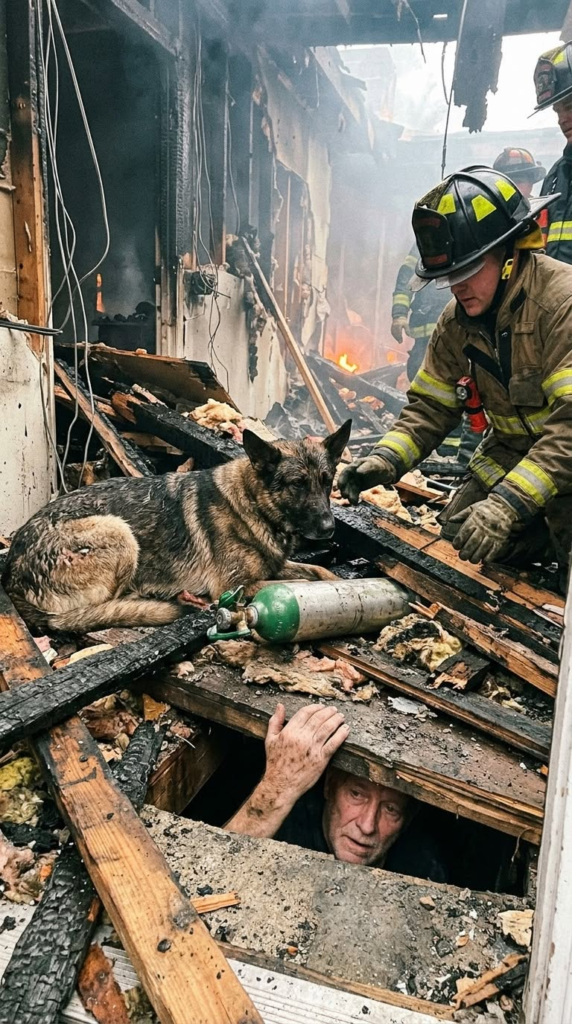
A German Shepherd was lying in the middle of the destruction, covered in dust, surrounded by broken bricks and shattered wood, with her injured body wrapped tightly around a green oxygen tank as if that single metal cylinder was the only thing keeping the entire world from falling apart.
At first, everyone believed she was afraid.
Then we thought she was aggressive.
=
But we were wrong.
My name is Ethan Walker, and at the time I was thirty-eight years old, working as the lead responder for the Tulsa Emergency Motorcycle Rescue Unit in Oklahoma. For almost fifteen years, my job had been running toward situations most people were desperate to escape from. I had entered burning buildings, pulled victims from wrecked vehicles, searched through flooded neighborhoods, and crawled through unstable structures where every movement could trigger another collapse.
But nothing prepared me for what happened on East Forty-First Street.
The emergency call came in at 3:07 on a Tuesday afternoon.
The report was short.
House explosion.
Possible gas leak.
Unknown number of people inside.
When our rescue motorcycles turned onto the street, we immediately knew it was worse than the first report suggested.
A small brick home sat behind a cloud of black smoke. The entire front section had been destroyed. The porch had collapsed into the yard. Windows were blown outward. Pieces of the roof had fallen into what used to be the living room, and flames were moving through the upper part of the structure in thin orange lines.
The smell of natural gas filled the air.
That was always the part firefighters feared most.
Fire could be seen.
Smoke could be avoided.
But gas could wait silently until one wrong spark turned everything into another explosion.
Police officers had already evacuated the surrounding homes. Neighbors stood behind the barricades, watching with terrified expressions while firefighters searched for any sign of survivors.
A woman from across the street approached us, holding a blanket around her shoulders.
“Please,” she said. “You have to find Rebecca.”
I turned toward her.
“Rebecca?”
“Rebecca Lawson. She lives there.”
“Was anyone else inside?”
The woman hesitated.
“I don’t know.”
Her eyes moved toward the destroyed house.
“She has a dog. A German Shepherd. They are always together.”
I looked at the burning structure.
The information changed everything.
A missing person was one problem.
A missing person and an animal trapped inside a collapsing building was another.
My partner, Samuel “Sam” Cooper, adjusted his helmet and looked toward the smoke.
Sam was the kind of person nobody expected to become a rescue worker when they first met him. He had a quiet personality, a patient voice, and a habit of talking calmly even during the worst situations. While others focused on the chaos, Sam always noticed the smallest details.
And that afternoon, the smallest detail was the sound.
“Wait.”
I looked at him.
“What?”
He lifted his hand.
The entire team became silent.
For a few seconds, all we heard was the crackling of fire and the distant sound of emergency vehicles.
Then it came.
A low, rough noise from inside the house.
Not a normal bark.
Not a cry.
A warning.
Sam looked at me.
“There is something alive in there.”
We moved quickly toward the damaged entrance.
The heat increased with every step.
Pieces of burned wood fell from above.
The floor beneath us was unstable, forcing us to move carefully.
We followed the sound toward the kitchen area, where a section of the ceiling had collapsed completely.
A large wooden cabinet had fallen across the floor.
Behind it, something moved.
“Clear the area,” I called.
Two firefighters helped us remove the broken cabinet while another crew lifted a heavy piece of collapsed roofing.
Dust exploded into the air.
Then everything stopped.
Because we saw her.
The German Shepherd was lying inside a narrow opening beneath the debris.
She was large, probably around seventy pounds, with a black-and-tan coat that had once been beautiful. Now, most of her fur was covered in gray plaster dust. The fur along her back had been burned by the heat, leaving damaged patches of skin visible underneath.
One side of her body was shaking.
Her paws were scraped and bleeding.
She was clearly injured.
But she refused to move.
Because beneath her chest was an oxygen tank.
A green medical cylinder.
At first, I thought we had found a dog protecting something valuable.
The scene made sense.
The refrigerator had fallen open nearby. Food containers were scattered across the floor. The house was filled with unfamiliar people, loud noises, and danger.
A frightened animal might protect anything.
Even something meaningless.
Sam slowly lowered himself.
“Easy, girl.”
The German Shepherd immediately lifted her head.
Her eyes locked onto him.
She did not bark.
She did not attack.
But when Sam reached forward, her lips pulled back slightly.
Her teeth showed.
Everyone stopped.
“She’s warning us,” one firefighter said.
Sam nodded.
“She’s scared.”
I studied the dog carefully.
Something about her behavior bothered me.
She wasn’t looking at us.
Not really.
Every few seconds, her eyes moved away from the rescue team and toward the collapsed staircase behind her.
Then back to the oxygen tank.
Then back to the staircase.
I took one step closer.
The dog pressed her body harder against the cylinder.
Her entire frame tightened.
“She’s not guarding the tank,” I said quietly.
Sam looked at me.
“What do you mean?”
I pointed.
“Watch her eyes.”
The German Shepherd looked toward the darkness beneath the collapsed stairs again.
Then she lowered her head over the oxygen tank.
As if she was protecting the connection between the two.
A firefighter beside me reached for the cylinder.
Immediately, the dog’s entire body changed.
She moved across the tank, covering the valve with her chest.
A deep warning sound came from her throat.
Not anger.
Fear.
“Nobody touch it,” I said.
The firefighter looked confused.
“We need to remove that tank. The fire is spreading.”
“I know.”
I moved closer, carefully watching the dog.
Then I saw it.
A clear oxygen tube ran from the cylinder.
It disappeared beneath the German Shepherd’s front legs.
Then continued across the broken floor.
Straight toward the collapsed staircase.
My heart dropped.
“Sam.”
He followed the tube.
His expression changed instantly.
“Oh my God.”
The entire room became quiet.
Because we all understood.
The dog wasn’t protecting the oxygen tank.
She was protecting the oxygen line.
Someone was connected to it.
Someone was underneath the rubble.
Before anyone could speak, a faint sound came from beneath the collapsed staircase.
A breath.
Then another.
Then a weak voice.
“Please…”
The German Shepherd’s ears lifted.
Her tail moved once against the concrete.
She looked back at the darkness.
Then at us.
And in that moment, we finally understood why she had refused to leave.
The injured dog wasn’t trapped inside the burning house.
She had chosen to stay.
Because someone beneath those ruins was still alive.
And she was the only thing standing between that person and death.

PART 2
For several seconds, nobody moved.
The flames continued spreading through the upper part of the house. Smoke pushed through the broken windows. Somewhere above us, damaged wooden beams groaned under the weight of the collapsed roof. Every firefighter inside that room understood the same thing at the same moment.
We were running out of time.
But the German Shepherd had already spent more time fighting for that hidden person than any of us could imagine.
She had stayed beside the oxygen tank while the house burned around her. She had ignored her own injuries. She had endured the heat, the smoke, and the pain because she knew one thing that we didn’t.
Someone was still breathing beneath the rubble.
I immediately grabbed my radio.
“Command, this is Rescue Unit Seven. We have a confirmed survivor trapped beneath the collapsed staircase. Possible medical oxygen dependency. Beginning extraction immediately.”
The response came through the static.
“Copy, Rescue Seven. Structural integrity is compromised. You have limited time.”
Limited time.
Those words followed us everywhere.
They followed us into burning buildings.
They followed us into flooded streets.
They followed us into every situation where someone’s life depended on whether we could move faster than the disaster around us.
But this time, there was another problem.
The dog.
The German Shepherd refused to move away from the oxygen cylinder.
And after watching her for only a few seconds, I understood why.
She wasn’t being stubborn.
She was terrified.
Not of us.
Of losing the connection to the person underneath the stairs.
I slowly removed my gloves.
Sam looked at me.
“What are you doing?”
“Talking to her.”
“You think she’ll understand?”
I looked at the dog.
“I think she already understands more than we do.”
I lowered myself to the floor.
The German Shepherd watched every movement.
Her breathing was heavy. The burns along her back clearly caused her pain, but she still kept her body between us and the oxygen tank.
“Hey, girl.”
Her ears moved slightly.
“My name is Ethan.”
The dog stared at me.
“We know someone is down there.”
Her eyes immediately shifted toward the collapsed staircase.
That reaction told me everything.
“You did good.”
The dog’s expression softened slightly.
“You kept them alive.”
For a moment, the fire around us seemed quieter.
Then I slowly reached toward the oxygen line.
The German Shepherd immediately lowered her head.
Her muscles tightened.
I stopped.
“Okay.”
I pulled my hand back.
“No sudden moves.”
Sam moved closer.
“We need to get that cylinder closer to the opening. The tube is stretched.”
I looked at the line.
He was right.
The oxygen tank had been dragged several feet away from where it originally belonged. The dog had somehow managed to pull it through the destruction and position herself beside it.
But now the cylinder was becoming dangerous.
Heat was increasing.
The pressure gauge was exposed.
And if the flames reached it, the situation could become catastrophic.
“We need a way to move it without breaking the connection,” I said.
A firefighter named Olivia Hayes entered the room carrying a protective blanket.
“Could we slide the tank?”
The German Shepherd immediately looked at her.
Olivia stopped.
“She knows.”
Everyone looked at her.
“She knows we’re trying to help,” Olivia continued. “She’s just afraid we’ll disconnect it.”
The statement was simple.
But it changed the way we saw the dog.
She wasn’t a problem.
She was part of the rescue.
I moved slowly toward the oxygen tank.
This time, I did not reach for it.
Instead, I placed my hand on the floor beside the dog.
The German Shepherd watched.
Then, after several seconds, she lowered her head.
Not completely.
Just enough.
A small sign of trust.
“That’s it,” I whispered.
Together, we carefully adjusted the cylinder.
The dog followed every movement.
Whenever the tube tightened, she moved.
Whenever the line became loose, she relaxed.
It was unbelievable.
She wasn’t just guarding the oxygen.
She was monitoring it.
She knew exactly what position it needed to be in.
Sam stared at her.
“I’ve seen trained service dogs before.”
He shook his head.
“But this…”
He couldn’t finish.
None of us could.
Because the truth was becoming clearer.
This wasn’t random behavior.
This was a dog who had spent years learning how to care for someone.
We finally created enough space to reach the collapsed staircase.
I crawled forward with a flashlight.
The opening was barely wide enough for my shoulders.
Smoke filled the small space.
The oxygen tube disappeared into the darkness.
“Rebecca?”
For a few seconds, there was no answer.
Then…
“Here.”
The voice was weak.
But alive.
“Rebecca Lawson?”
“Yes.”
“I’m Captain Ethan Walker. We’re going to get you out.”
A pause.
Then a quiet reply.
“Is Daisy okay?”
I froze.
I looked back.
“Daisy?”
“My dog.”
I turned toward the German Shepherd.
The dog lifted her head.
That was her name.
Daisy.
“She’s right here.”
The moment I said those words, Rebecca started crying.
“She came back.”
I frowned.
“What do you mean?”
Rebecca’s voice shook.
“When the explosion happened, I couldn’t move.”
She coughed.
“I dropped my oxygen tank. Daisy dragged it to me.”
Everyone became silent.
The story was impossible.
Yet the evidence was right in front of us.
Rebecca continued.
“She pulled the tank across the floor. She pulled the tube toward me. Then she stayed there.”
Her voice broke.
“She wouldn’t leave.”
I looked at Daisy.
The dog was lying exactly where Rebecca had described.
Holding onto the only thing keeping her alive.
A firefighter beside me whispered:
“That dog saved her.”
But the rescue was not finished.
The debris around Rebecca was unstable. We needed to remove pieces carefully without causing the remaining structure to collapse.
For the next thirty minutes, Daisy stayed beside the oxygen tank.
The flames moved closer.
The smoke became thicker.
Her body grew weaker.
Several times, she lowered her head as though exhaustion was finally overcoming her.
But every time someone moved toward Rebecca, Daisy lifted her eyes.
She was still watching.
Still protecting.
Finally, after carefully removing the last piece of collapsed wood, we reached Rebecca.
She was trapped but conscious.
Two firefighters secured her while I crawled into the opening and prepared her for extraction.
When we pulled her free, she immediately reached toward Daisy.
The German Shepherd tried to stand.
She failed.
Her legs collapsed beneath her.
I caught her before she hit the floor.
Rebecca began crying.
“Daisy…”
The dog looked at her.
And for the first time since we found her, Daisy relaxed.
Her ears lowered.
Her eyes closed.
She knew.
Rebecca was safe.
Only then did she allow herself to be rescued.
Outside the burning house, paramedics treated both of them.
Rebecca was transported to the hospital with injuries from the collapse.
Daisy was taken to an emergency veterinary clinic.
As I watched the ambulance doors close, I couldn’t stop thinking about what we had witnessed.
Everyone had entered that house believing we were there to save the dog.
But the truth was different.
The dog had been saving someone else the entire time.
And she had done it while surrounded by fire.
PART 3
The morning after the fire, the city of Tulsa woke up to images of the destroyed house on East Forty-First Street appearing across local news channels.
People saw the collapsed roof.
They saw the blackened walls.
They saw firefighters standing in front of the ruins where a family’s memories had once existed.
But what they did not immediately see was the part of the story that stayed with everyone who had been there.
They did not see the injured German Shepherd named Daisy lying beneath the smoke and dust.
They did not see the way she had refused to abandon the oxygen tank.
They did not see the way she had used every bit of strength left in her body to protect the person who had once protected her.
A few days after the rescue, I visited Daisy at the animal emergency hospital.
I had seen many injured animals during my career. Some were frightened. Some were confused. Some were too exhausted to react at all.
But Daisy was different.
When I walked into the room, she lifted her head immediately.
Her injuries were serious, but the veterinarians had done an incredible job. The burns along her back had been treated. Her paws were wrapped because of cuts from broken glass and debris. She still moved slowly, but the fear I had seen inside the burning house was gone.
She recognized me.
The moment her eyes met mine, her tail moved gently against the blanket.
“Hey, Daisy.”
She tried to stand.
The veterinarian quickly placed a hand on her shoulder.
“Easy, girl. You still need rest.”
Daisy ignored the warning and looked toward the doorway.
She was searching.
Looking for someone.
I knew exactly who.
“Rebecca is coming.”
The dog relaxed.
That was when I realized something.
For all the attention Daisy received after the rescue, for all the headlines calling her a hero, Daisy never cared about any of that.
She didn’t understand television cameras.
She didn’t understand interviews.
She didn’t understand people calling her brave.
She only understood one thing.
Rebecca was safe.
Three days later, Rebecca Lawson arrived at the veterinary hospital.
She was still recovering from her injuries. She walked slowly with the help of a cane, but the first thing she asked was not about herself.
“Where is Daisy?”
The staff guided her into the recovery room.
The moment Daisy saw her, everything changed.
The tired German Shepherd that had barely been able to stand suddenly pushed herself upward.
Rebecca dropped to her knees.
“Daisy.”
The dog moved forward carefully.
Rebecca wrapped her arms around her neck.
For several seconds, neither of them moved.
Everyone in the room became silent.
Because there was no explanation needed.
They had found each other again.
Rebecca cried as she held her dog.
“You saved me.”
Daisy simply rested her head against her shoulder.
Later, Rebecca told us the story of how Daisy had entered her life.
Five years earlier, Daisy had been found wandering near a highway outside Tulsa.
She was young, scared, and injured.
Nobody knew where she came from.
Nobody knew who had abandoned her.
Animal control workers said she was nervous around strangers and struggled to trust people.
Many potential adopters passed her by.
But Rebecca didn’t.
“I saw a dog who was afraid of being hurt again,” she told me.
“Not a dangerous dog.”
“A lonely one.”
Rebecca spent months earning Daisy’s trust.
She sat beside her without forcing contact.
She spoke to her every day.
She taught her that not every hand reaching toward her was there to cause harm.
Eventually, Daisy changed.
She became Rebecca’s shadow.
She followed her from room to room.
She waited outside while Rebecca gardened.
She slept beside her chair every evening.
When Rebecca’s health began declining and she needed an oxygen tank, Daisy adapted.
She learned the sound of the machine.
She learned the smell of the equipment.
She learned how to stay close whenever Rebecca needed help.
Nobody knew that those small moments of care would one day prepare Daisy for the biggest moment of her life.
Months after the explosion, Rebecca returned to a rebuilt neighborhood.
Her old house was gone.
The structure had been declared unsafe and demolished.
But Rebecca said she didn’t care about the building.
“Home isn’t the walls,” she told me.
“It’s who waits inside.”
She moved into a smaller house on the edge of Tulsa with a large backyard where Daisy could walk freely.
When I visited them again, I found something completely different from the scene I remembered.
No smoke.
No flames.
No broken walls.
Instead, there was sunlight.
Flowers grew along the fence.
A small wooden ramp led to the porch.
And Daisy was lying peacefully beside Rebecca’s chair.
The same dog who had once been covered in ash was now sleeping in the afternoon warmth.
Rebecca smiled as she watched her.
“She still checks the oxygen machine every morning.”
I laughed.
“She does?”
Rebecca nodded.
“She walks over, looks at it, then looks at me.”
She paused.
“I think she just wants to make sure I’m still here.”
I looked at Daisy.
The German Shepherd opened one eye.
For a moment, I remembered the burning house.
The flames.
The collapsing ceiling.
The oxygen tank beneath her body.
The way everyone thought she was acting out of fear.
But they were wrong.
Daisy was not afraid.
She was loyal.
She was not guarding an object.
She was protecting a life.
Years have passed since that rescue on East Forty-First Street, but whenever someone asks me about the most unforgettable moment of my career, I never talk about the fire.
I don’t talk about the explosion.
I don’t talk about the dangerous conditions or the equipment we used.
I talk about Daisy.
The German Shepherd who was found burned and exhausted inside a collapsing home.
The dog who refused to move even when flames surrounded her.
The dog who ignored her own pain because someone else needed her.
Because that day taught me something I will never forget.
Heroes do not always arrive wearing uniforms.
Sometimes they have four legs.
Sometimes they are covered in dust.
Sometimes they are injured, exhausted, and afraid.
But when someone they love is in danger, they find a strength nobody knew they had.
And sometimes, the smallest heartbeat inside a burning house is the one that refuses to let another person stop breathing.